Thursday, April 10, 2008

BUDDY PIGG IN A CABBAGE

Once upon a time, not so many years ago ... it happened that there lived at one time, in a nice little house, called a pen, four guinea pigs.

There was the papa, and he was named Dr. Pigg, and the reason for it was that he had once been in the hospital with a broken paw, and ever since he was known as "Doctor." Then there was his wife, and his little boy, and his little girl. They were Montmorency and Matilda, but, as the children didn't like those names, they always spoke of each other as "Buddy" and "Brighteyes," so I will do the same.

Buddy Pigg (and he had two g's in his name you notice) was black and white, and Brighteyes Pigg was brown and white, and they were the nicest guinea pig children you could meet if you rode all week in an automobile. One day Buddy went out for a walk in the woods alone, because Brighteyes had to stay at home to help to do the dishes, and dust the furniture.

Buddy, who, I suppose, you remember, was a friend of Jackie and Peetie Bow Wow, walked along, sniffing with his nose, just like Sammie and Susie Littletail, the rabbits.

"It seems to me," Buddy said, "that I smell something good to eat. I wonder if it can be an ice cream cone, or some peanuts, or anything like that?" He looked around but he couldn't see any store there in the woods where they sold ice cream or peanuts, and then he knew he must be mistaken. Still he kept on smelling something good.

"I wonder where that is?" he exclaimed, and he sniffed harder than ever. And then he knew what it was—a cabbage—a great, big cabbage! He ran around the side of a big rock, and there lying on the path, was a fine big cabbage. Some one had dropped it by mistake.

"This is great luck!" cried Buddy Pigg. "There is enough for me and Brighteyes, and I can take some home to mamma and to my papa, the doctor. Yes, indeed, this has been a lucky day for me. I'm as glad I found this cabbage as if I had picked up ten cents! I guess I'll eat some to see how it tastes."

So Buddy Pigg began to gnaw at the cabbage and, as he had very good teeth for gnawing—almost as good as Sammy Littletail's—he soon had quite a hole made. But he kept on gnawing and eating away, so fine did it taste, until, in a little while if he hadn't eaten a hole right into the cabbage and he found himself inside, just like the mousie in the loaf of bread!

"Ha! This is very fine, indeed!" cried Buddy Pigg. "I think I will take a nap here," and lopsy-flop! if that little guinea pig didn't curl up inside the cabbage and go fast, fast asleep; and not even his tail stuck out, because, you see, he didn't have any tail—guinea pigs never do have any, which is a good thing, I suppose.

Well, Buddy Pigg was sleeping away inside that cabbage, dreaming of how nice it would be to take the rest of it home, when all at once, who should come creeping, creeping around the edge of the rock, but a great, big fox. He had sharp eyes, had that fox, and he saw the little guinea pig asleep inside the cabbage, even though Buddy's tail didn't stick out.

"Ah, ha! Oh, ho!" exclaimed the fox, and he smacked his lips. "I see a fine feast before me! Oh, yes, indeed, a very fine feast! Guinea pig flavored with cabbage! Now, just so that pig can't get out, I'll stop up that hole, while he's asleep in there, and I'll go and get my wife, and we'll come back and have a dandy meal! Oh! a most delectable meal!"

So that old fox crept softly, so softly, up to where the cabbage was, with Buddy asleep inside, and the fox took a stone, and he crowded it, and wedged it, fast in the hole, so poor Buddy couldn't get out, though there was some air for him to breathe. Then the fox laughed to himself: "Ha, ha!" and "Ho, ho!" and hurried off down the hill after his wife.

Well, it wasn't long before Buddy Pigg awoke, and he tried to stretch himself, as he always did after a nap, and wasn't he the surprised guinea pig, though, when he found he couldn't stretch!

"Why, what can be the matter?" he cried. "I'm all in the dark! Let's see where was I? Oh, I remember, I found a cabbage, and I began to eat it, and I went inside it—And land sakes, goodness me and a trolley car! I'm inside it now!" he cried, as he smelled the cabbage. "I'm shut in the cabbage just as if I was shut in a closet! However did it happen?" and he tried to turn around, and make his way out, but he couldn't, because the stone which the fox had stuffed in the hole closed it up too tight.

"I'm locked in!" cried Buddy Pigg. "Locked in a cabbage! Isn't it terrible!" and of course it was, and no fooling, either.

Well, Buddy Pigg was a brave little chap, and instead of sitting down and crying there in the dark, he began to think of how he could get out. He thought of all sorts of ways, but none of them seemed any good, and at last he decided to try to burst the cabbage open. But it was too strong and thick, and he couldn't do it.

He soon discovered, however, that, wiggling around inside it as he did, made the cabbage wiggle too, and the first thing you know the cabbage began to roll down the hill, just like a man in a barrel.

Faster and faster went the cabbage down the hill, over and over, with Buddy inside, and he began to get dizzy, for he didn't know what was happening.

Then, at that moment, who should come along but that bad fox and his wife. The cabbage seemed to be rolling straight at them.

"My sakes alive!" cried Mrs. Fox. "What is that, Oscar?" You see her husband's name was Oscar.

"I don't know," he replied, "but don't bother about it. We'll go and get that guinea pig." So they kept on, but just then the cabbage bounded over a little clod of dirt, went up in the air, and nearly hit Mr. Fox, and that scared him so that he ran away, and his wife ran after him.

Well, the cabbage, with Buddy inside, kept on rolling, and the first thing you know it began to roll down hill in front of the guinea pigs' pen. It made quite a noise, and Matilda ran out to see what it was.

"Oh, mamma!" she cried. "Here is a cabbage rolling down hill."

"Nonsense!" cried Mrs. Pigg. "Whoever heard of such a thing?" but she ran out to see what it was, and at that moment the cabbage bounded right in front of the pen, hit a big stone, burst open with a noise like a torpedo, and out rolled Buddy Pigg, over and over, just like a pumpkin. But, believe me, he wasn't hurt the least mite, but he was rather surprised-like!

Then he got up, walked over to his mother and said:

"Here is some fresh cabbage I brought home," and he was as cool as two cucumbers. Well, the guinea pigs had a fine dinner off the cabbage Buddy brought home in such a funny way, and of course the fox and his wife didn't have any, which served them right I suppose.

Wednesday, April 9, 2008

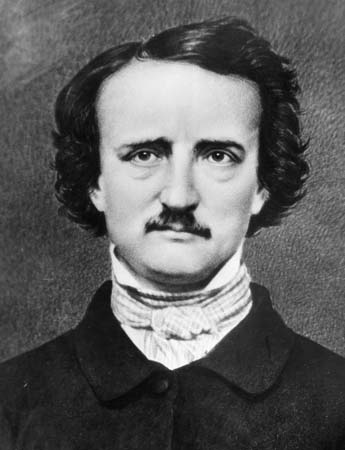
THE ANGEL OF THE ODD

http://robertarood.files.wordpress.com/2007/07/poe.jpg


It was a chilly November afternoon. I had just consummated an unusually hearty dinner, of which the dyspeptic truffe formed not the least important item, and was sitting alone in the dining-room with my feet upon the fender and at my elbow a small table which I had rolled up to the fire, and upon which were some apologies for dessert, with some miscellaneous bottles of wine, spirit, and liqueur. In the morning I had been reading Glover's Leonidas, Wilkie's Epigoniad, Lamartine's Pilgrimage, Barlow's Columbiad, Tuckerman's Sicily, and Griswold's Curiosities, I am willing to confess, therefore, that I now felt a little stupid. I made effort to arouse myself by frequent aid of Lafitte, and all failing, I betook myself to a stray newspaper in despair. Having carefully perused the column of "Houses to let," and the column of "Dogs lost," and then the columns of "Wives and apprentices runaway," I attacked with great resolution the editorial matter, and reading it from beginning to end without understanding a syllable, conceived the possibility of its being Chinese, and so re-read it from the end to the beginning, but with no more satisfactory result. I was about throwing away in disgust

This folio of four pages, happy work
Which not even critics criticise,

when I felt my attention somewhat aroused by the paragraph which follows:

"The avenues to death are numerous and strange. A London paper mentions the decease of a person from a singular cause. He was playing at 'puff the dart,' which is played with a long needle inserted in some worsted, and blown at a target through a tin tube. He placed the needle at the wrong end of the tube, and drawing his breath strongly to puff the dart forward with force, drew the needle into his throat. It entered the lungs, and in a few days killed him."

Upon seeing this I fell into a great rage, without exactly knowing why. "This thing," I exclaimed, "is a contemptible falsehood--a poor hoax--the lees of the invention of some pitiable penny-a-liner, of some wretched concocter of accidents in Cocaigne. These fellows knowing the extravagant gullibility of the age set their wits to work in the imagination of improbable possibilities, of odd accidents as they term them, but to a reflecting intellect (like mine, I added, in parenthesis, putting my forefinger unconsciously to the side of my nose), to a contemplative understanding such as I myself possess, it seems evident at once that the marvelous increase of late in these 'odd accidents' is by far the oddest accident of all. For my own part, I intend to believe nothing henceforward that has anything of the 'singular' about it."

"Mein Gott, den, vat a vool you bees for dat!" replied one of the most remarkable voices I ever heard. At first I took it for a rumbling in my ears--such as a man sometimes experiences when getting very drunk--but upon second thought, I considered the sound as more nearly resembling that which proceeds from an empty barrel beaten with a big stick; and, in fact, this I should have concluded it to be, but for the articulation of the syllables and words. I am by no means naturally nervous, and the very few glasses of Lafitte which I had sipped served to embolden me a little, so that I felt nothing of trepidation, but merely uplifted my eyes with a leisurely movement and looked carefully around the room for the intruder. I could not, however, perceive any one at all.

"Humph!" resumed the voice as I continued my survey, "you mus pe so dronk as de pig den for not zee me as I zit here at your zide."

Hereupon I bethought me of looking immediately before my nose, and there, sure enough, confronting me at the table sat a personage nondescript, although not altogether indescribable. His body was a wine-pipe or a rum puncheon, or something of that character, and had a truly Falstaffian air. In its nether extremity were inserted two kegs, which seemed to answer all the purposes of legs. For arms there dangled from the upper portion of the carcass two tolerably long bottles with the necks outward for hands. All the head that I saw the monster possessed of was one of those Hessian canteens which resemble a large snuff-box with a hole in the middle of the lid. This canteen (with a funnel on its top like a cavalier cap slouched over the eyes) was set on edge upon the puncheon, with the hole toward myself; and through this hole, which seemed puckered up like the mouth of a very precise old maid, the creature was emitting certain rumbling and grumbling noises which he evidently intended for intelligible talk.

"I zay," said he, "you mos pe dronk as de pig, vor zit dare and not zee me zit ere; and I zay, doo, you mos pe pigger vool as de goose, vor to dispelief vat iz print in de print. 'Tiz de troof--dat it iz--ebery vord ob it."

"Who are you, pray?" said I with much dignity, although somewhat puzzled; "how did you get here? and what is it you are talking about?"

"As vor ow I com'd ere," replied the figure, "dat iz none of your pizziness; and as vor vat I be talking apout, I be talk apout vat I tink proper; and as vor who I be, vy dat is de very ting I com'd here for to let you zee for yourself."

"You are a drunken vagabond," said I, "and I shall ring the bell and order my footman to kick you into the street."

"He! he! he!" said the fellow, "hu! hu! hu! dat you can't do."

"Can't do!" said I, "what do you mean? I can't do what?"

"Ring de pell," he replied, attempting a grin with his little villainous mouth.

Upon this I made an effort to get up in order to put my threat into execution, but the ruffian just reached across the table very deliberately, and hitting me a tap on the forehead with the neck of one of the long bottles, knocked me back into the armchair from which I had half arisen. I was utterly astounded, and for a moment was quite at a loss what to do. In the meantime he continued his talk.

"You zee," said he, "it iz te bess vor zit still; and now you shall know who I pe. Look at me! zee! I am te _Angel ov te Odd_."

"And odd enough, too," I ventured to reply; "but I was always under the impression that an angel had wings."

"Te wing!" he cried, highly incensed, "vat I pe do mit te wing? Mein Gott! do you take me for a shicken?"

"No--oh, no!" I replied, much alarmed; "you are no chicken--certainly not."

"Well, den, zit still and pehabe yourself, or I'll rap you again mid me vist. It iz te shicken ab te wing, und te owl ab te wing, und te imp ab te wing, und te head-teuffel ab te wing. Te angel ab _not_ te wing, and I am te _Angel ov te Odd_."

"And your business with me at present is--is----"

"My pizziness!" ejaculated the thing, "vy vat a low-bred puppy you mos pe vor to ask a gentleman und an angel apout his pizziness!"

This language was rather more than I could bear, even from an angel; so, plucking up courage, I seized a salt-cellar which lay within reach, and hurled it at the head of the intruder. Either he dodged, however, or my aim was inaccurate; for all I accomplished was the demolition of the crystal which protected the dial of the clock upon the mantelpiece. As for the Angel, he evinced his sense of my assault by giving me two or three hard, consecutive raps upon the forehead as before. These reduced me at once to submission, and I am almost ashamed to confess that, either through pain or vexation, there came a few tears into my eyes.

"Mein Gott!" said the Angel of the Odd, apparently much softened at my distress; "mein Gott, te man is eder ferry dronk or ferry zorry. You mos not trink it so strong--you mos put te water in te wine. Here, trink dis, like a good veller, and don't gry now--don't!"

Hereupon the Angel of the Odd replenished my goblet (which was about a third full of port) with a colorless fluid that he poured from one of his hand-bottles. I observed that these bottles had labels about their necks, and that these labels were inscribed "Kirschenwässer."

The considerate kindness of the Angel mollified me in no little measure; and, aided by the water with which he diluted my port more than once, I at length regained sufficient temper to listen to his very extraordinary discourse. I cannot pretend to recount all that he told me, but I gleaned from what he said that he was a genius who presided over the contretemps of mankind, and whose business it was to bring about the odd accidents which are continually astonishing the skeptic. Once or twice, upon my venturing to express my total incredulity in respect to his pretensions, he grew very angry indeed, so that at length I considered it the wiser policy to say nothing at all, and let him have his own way. He talked on, therefore, at great length, while I merely leaned back in my chair with my eyes shut, and amused myself with munching raisins and flipping the stems about the room. But, by and by, the Angel suddenly construed this behavior of mine into contempt. He arose in a terrible passion, slouched his funnel down over his eyes, swore a vast oath, uttered a threat of some character, which I did not precisely comprehend, and finally made me a low bow and departed, wishing me, in the language of the archbishop in "Gil Bias," beaucoup de bonheur et un peu plus de bon sens.

His departure afforded me relief. The very few glasses of Lafitte that I had sipped had the effect of rendering me drowsy, and I felt inclined to take a nap of some fifteen or twenty minutes, as is my custom after dinner. At six I had an appointment of consequence, which it was quite indispensable that I should keep. The policy of insurance for my dwelling-house had expired the day before; and some dispute having arisen it was agreed that, at six, I should meet the board of directors of the company and settle the terms of a renewal. Glancing upward at the clock on the mantelpiece (for I felt too drowsy to take out my watch), I had the pleasure to find that I had still twenty-five minutes to spare. It was half-past five; I could easily walk to the insurance office in five minutes; and my usual siestas had never been known to exceed five-and-twenty. I felt sufficiently safe, therefore, and composed myself to my slumbers forthwith.

Having completed them to my satisfaction, I again looked toward the timepiece, and was half inclined to believe in the possibility of odd accidents when I found that, instead of my ordinary fifteen or twenty minutes, I had been dozing only three; for it still wanted seven-and-twenty of the appointed hour. I betook myself again to my nap, and at length a second time awoke, when, to my utter amazement, it still wanted twenty-seven minutes of six. I jumped up to examine the clock, and found that it had ceased running. My watch informed me that it was half-past seven; and, of course, having slept two hours, I was too late for my appointment. "It will make no difference," I said: "I can call at the office in the morning and apologize; in the meantime what can be the matter with the clock?" Upon examining it I discovered that one of the raisin stems which I had been filiping about the room during the discourse of the Angel of the Odd had flown through the fractured crystal, and lodging, singularly enough, in the keyhole, with an end projecting outward, had thus arrested the revolution of the minute hand.

"Ah!" said I, "I see how it is. This thing speaks for itself. A natural accident, such as will happen now and then!"

I gave the matter no further consideration, and at my usual hour retired to bed. Here, having placed a candle upon a reading stand at the bed head, and having made an attempt to peruse some pages of the Omnipresence of the Deity, I unfortunately fell asleep in less than twenty seconds, leaving the light burning as it was.

My dreams were terrifically disturbed by visions of the Angel of the Odd. Methought he stood at the foot of the couch, drew aside the curtains, and in the hollow, detestable tones of a rum puncheon, menaced me with the bitterest vengeance for the contempt with which I had treated him. He concluded a long harangue by taking off his funnel-cap, inserting the tube into my gullet, and thus deluging me with an ocean of Kirschenwässer, which he poured in a continuous flood, from one of the long-necked bottles that stood him instead of an arm. My agony was at length insufferable, and I awoke just in time to perceive that a rat had run off with the lighted candle from the stand, but _not_ in season to prevent his making his escape with it through the hole, Very soon a strong, suffocating odor assailed my nostrils; the house, I clearly perceived, was on fire. In a few minutes the blaze broke forth with violence, and in an incredibly brief period the entire building was wrapped in flames. All egress from my chamber, except through a window, was cut off. The crowd, however, quickly procured and raised a long ladder. By means of this I was descending rapidly, and in apparent safety, when a huge hog, about whose rotund stomach, and indeed about whose whole air and physiognomy, there was something which reminded me of the Angel of the Odd--when this hog, I say, which hitherto had been quietly slumbering in the mud, took it suddenly into his head that his left shoulder needed scratching, and could find no more convenient rubbing-post than that afforded by the foot of the ladder. In an instant I was precipitated, and had the misfortune to fracture my arm.

This accident, with the loss of my insurance, and with the more serious loss of my hair, the whole of which had been singed off by the fire, predisposed me to serious impressions, so that finally I made up my mind to take a wife. There was a rich widow disconsolate for the loss of her seventh husband, and to her wounded spirit I offered the balm of my vows. She yielded a reluctant consent to my prayers. I knelt at her feet in gratitude and adoration. She blushed and bowed her luxuriant tresses into close contact with those supplied me temporarily by Grandjean. I know not how the entanglement took place but so it was. I arose with a shining pate, wigless; she in disdain and wrath, half-buried in alien hair. Thus ended my hopes of the widow by an accident which could not have been anticipated, to be sure, but which the natural sequence of events had brought about.

Without despairing, however, I undertook the siege of a less implacable heart. The fates were again propitious for a brief period, but again a trivial incident interfered. Meeting my betrothed in an avenue thronged with the elite of the city, I was hastening to greet her with one of my best considered bows, when a small particle of some foreign matter lodging in the corner of my eye rendered me for the moment completely blind. Before I could recover my sight, the lady of my love had disappeared--irreparably affronted at what she chose to consider my premeditated rudeness in passing her by ungreeted. While I stood bewildered at the suddenness of this accident (which might have happened, nevertheless, to any one under the sun), and while I still continued incapable of sight, I was accosted by the Angel of the Odd, who proffered me his aid with a civility which I had no reason to expect. He examined my disordered eye with much gentleness and skill, informed me that I had a drop in it, and (whatever a "drop" was) took it out, and afforded me relief.

I now considered it high time to die (since fortune had so determined to persecute me), and accordingly made my way to the nearest river. Here, divesting myself of my clothes (for there is no reason why we cannot die as we were born), I threw myself headlong into the current; the sole witness of my fate being a solitary crow that had been seduced into the eating of brandy-saturated corn, and so had staggered away from his fellows. No sooner had I entered the water than this bird took it into his head to fly away with the most indispensable portion of my apparel. Postponing, therefore, for the present, my suicidal design, I just slipped my nether extremities into the sleeves of my coat, and betook myself to a pursuit of the felon with all the nimbleness which the case required and its circumstances would admit. But my evil destiny attended me still. As I ran at full speed, with my nose up in the atmosphere, and intent only upon the purloiner of my property, I suddenly perceived that my feet rested no longer upon terra firma; the fact is, I had thrown myself over a precipice, and should inevitably have been dashed to pieces but for my good fortune in grasping the end of a long guide-rope, which depended from a passing balloon.

As soon as I sufficiently recovered my senses to comprehend the terrific predicament in which I stood, or rather hung, I exerted all the power of my lungs to make that predicament known to the aeronaut overhead. But for a long time I exerted myself in vain. Either the fool could not, or the villain would not perceive me. Meanwhile the machine rapidly soared, while my strength even more rapidly failed. I was soon upon the point of resigning myself to my fate, and dropping quietly into the sea, when my spirits were suddenly revived by hearing a hollow voice from above, which seemed to be lazily humming an opera air. Looking up, I perceived the Angel of the Odd. He was leaning, with his arms folded, over the rim of the car; and with a pipe in his mouth, at which he puffed leisurely, seemed to be upon excellent terms with himself and the universe. I was too much exhausted to speak, so I merely regarded him with an imploring air.

For several minutes, although he looked me full in the face, he said nothing. At length, removing carefully his meerschaum from the right to the left corner of his mouth, he condescended to speak.

"Who pe you," he asked, "und what der teuffel you pe do dare?"

To this piece of impudence, cruelty, and affectation, I could reply only by ejaculating the monosyllable "Help!"

"Elp!" echoed the ruffian, "not I. Dare iz te pottle--elp yourself, und pe tam'd!"

With these words he let fall a heavy bottle of Kirschenwässer, which, dropping precisely upon the crown of my head, caused me to imagine that my brains were entirely knocked out. Impressed with this idea I was about to relinquish my hold and give up the ghost with a good grace, when I was arrested by the cry of the Angel, who bade me hold on.

"'Old on!" he said: "don't pe in te 'urry--don't. Will you pe take de odder pottle, or 'ave you pe got zober yet, and come to your zenzes?"

I made haste, hereupon, to nod my head twice--once in the negative, meaning thereby that I would prefer not taking the other bottle at present; and once in the affirmative, intending thus to imply that I was sober and had positively come to my senses. By these means I somewhat softened the Angel.

"Und you pelief, ten," he inquired, "at te last? You pelief, ten, in te possibility of te odd?"

I again nodded my head in assent.

"Und you ave pelief in me, te Angel of te Odd?"

I nodded again.

"Und you acknowledge tat you pe te blind dronk und te vool?"

I nodded once more.

"Put your right hand into your left preeches pocket, ten, in token ov your vull zubmizzion unto te Angel ov te Odd."

This thing, for very obvious reasons, I found it quite impossible to do. In the first place, my left arm had been broken in my fall from the ladder, and therefore, had I let go my hold with the right hand I must have let go altogether. In the second place, I could have no breeches until I came across the crow. I was therefore obliged, much to my regret, to shake my head in the negative, intending thus to give the Angel to understand that I found it inconvenient, just at that moment, to comply with his very reasonable demand! No sooner, however, had I ceased shaking my head than--

"Go to der teuffel, ten!" roared the Angel of the Odd.

In pronouncing these words he drew a sharp knife across the guide-rope by which I was suspended, and as we then happened to be precisely over my own house (which, during my peregrinations, had been handsomely rebuilt), it so occurred that I tumbled headlong down the ample chimney and alit upon the dining-room hearth.

Upon coming to my senses (for the fall had very thoroughly stunned me) I found it about four o'clock in the morning. I lay outstretched where I had fallen from the balloon. My head groveled in the ashes of an extinguished fire, while my feet reposed upon the wreck of a small table, overthrown, and amid the fragments of a miscellaneous dessert, intermingled with a newspaper, some broken glasses and shattered bottles, and an empty jug of the Schiedam Kirschenwässer. Thus revenged himself the Angel of the Odd.

Saturday, April 5, 2008

Mountain Story - An interesting short story

http://www.trekkingbritain.com/051126-conistonoldmanfromconiston/20051126N-WoodyWalkingUpConistonOldMan.jpg

"A son and his father were walking on the mountains.
Suddenly, his son falls, hurts himself and screams: "AAAhhhhhhhhhhh!!!"
To his surprise, he hears the voice repeating, somewhere in the mountain: "AAAhhhhhhhhhhh!!!"
Curious, he yells: "Who are you?"
He receives the answer: "Who are you?"
And then he screams to the mountain: "I admire you!"
The voice answers: "I admire you!"
Angered at the response, he screams: "Coward!"
He receives the answer: "Coward!"
He looks to his father and asks: "What's going on?"
The father smiles and says: "My son, pay attention."
Again the man screams: "You are a champion!"
The voice answers: "You are a champion!"
The boy is surprised, but does not understand.
Then the father explains: "People call this ECHO, but really this is LIFE.
It gives you back everything you say or do.
Our life is simply a reflection of our actions.
If you want more love in the world, create more love in your heart.
If you want more competence in your team, improve your competence.
This relationship applies to everything, in all aspects of life;
Life will give you back everything you have given to it."

YOUR LIFE IS NOT A COINCIDENCE. IT'S A REFLECTION OF YOU!"

Friday, April 4, 2008

To Build a Fire

The image “http://pfpack121.org/images/l31wp1j2%5B1%5D.gif” cannot be displayed, because it contains errors.


Day had broken cold and grey, exceedingly cold and grey, when the man turned aside from the main Yukon trail and climbed the high earth- bank, where a dim and little-travelled trail led eastward through the fat spruce timberland. It was a steep bank, and he paused for breath at the top, excusing the act to himself by looking at his watch. It was nine o'clock. There was no sun nor hint of sun, though there was not a cloud in the sky. It was a clear day, and yet there seemed an intangible pall over the face of things, a subtle gloom that made the day dark, and that was due to the absence of sun. This fact did not worry the man. He was used to the lack of sun. It had been days since he had seen the sun, and he knew that a few more days must pass before that cheerful orb, due south, would just peep above the sky- line and dip immediately from view.

The man flung a look back along the way he had come. The Yukon lay a mile wide and hidden under three feet of ice. On top of this ice were as many feet of snow. It was all pure white, rolling in gentle undulations where the ice-jams of the freeze-up had formed. North and south, as far as his eye could see, it was unbroken white, save for a dark hair-line that curved and twisted from around the spruce- covered island to the south, and that curved and twisted away into the north, where it disappeared behind another spruce-covered island. This dark hair-line was the trail--the main trail--that led south five hundred miles to the Chilcoot Pass, Dyea, and salt water; and that led north seventy miles to Dawson, and still on to the north a thousand miles to Nulato, and finally to St. Michael on Bering Sea, a thousand miles and half a thousand more.

But all this--the mysterious, far-reaching hairline trail, the absence of sun from the sky, the tremendous cold, and the strangeness and weirdness of it all--made no impression on the man. It was not because he was long used to it. He was a new-comer in the land, a chechaquo, and this was his first winter. The trouble with him was that he was without imagination. He was quick and alert in the things of life, but only in the things, and not in the significances. Fifty degrees below zero meant eighty odd degrees of frost. Such fact impressed him as being cold and uncomfortable, and that was all. It did not lead him to meditate upon his frailty as a creature of temperature, and upon man's frailty in general, able only to live within certain narrow limits of heat and cold; and from there on it did not lead him to the conjectural field of immortality and man's place in the universe. Fifty degrees below zero stood for a bite of frost that hurt and that must be guarded against by the use of mittens, ear-flaps, warm moccasins, and thick socks. Fifty degrees below zero was to him just precisely fifty degrees below zero. That there should be anything more to it than that was a thought that never entered his head.

As he turned to go on, he spat speculatively. There was a sharp, explosive crackle that startled him. He spat again. And again, in the air, before it could fall to the snow, the spittle crackled. He knew that at fifty below spittle crackled on the snow, but this spittle had crackled in the air. Undoubtedly it was colder than fifty below--how much colder he did not know. But the temperature did not matter. He was bound for the old claim on the left fork of Henderson Creek, where the boys were already. They had come over across the divide from the Indian Creek country, while he had come the roundabout way to take a look at the possibilities of getting out logs in the spring from the islands in the Yukon. He would be in to camp by six o'clock; a bit after dark, it was true, but the boys would be there, a fire would be going, and a hot supper would be ready. As for lunch, he pressed his hand against the protruding bundle under his jacket. It was also under his shirt, wrapped up in a handkerchief and lying against the naked skin. It was the only way to keep the biscuits from freezing. He smiled agreeably to himself as he thought of those biscuits, each cut open and sopped in bacon grease, and each enclosing a generous slice of fried bacon.

He plunged in among the big spruce trees. The trail was faint. A foot of snow had fallen since the last sled had passed over, and he was glad he was without a sled, travelling light. In fact, he carried nothing but the lunch wrapped in the handkerchief. He was surprised, however, at the cold. It certainly was cold, he concluded, as he rubbed his numbed nose and cheek-bones with his mittened hand. He was a warm-whiskered man, but the hair on his face did not protect the high cheek-bones and the eager nose that thrust itself aggressively into the frosty air.

At the man's heels trotted a dog, a big native husky, the proper wolf-dog, grey-coated and without any visible or temperamental difference from its brother, the wild wolf. The animal was depressed by the tremendous cold. It knew that it was no time for travelling. Its instinct told it a truer tale than was told to the man by the man's judgment. In reality, it was not merely colder than fifty below zero; it was colder than sixty below, than seventy below. It was seventy-five below zero. Since the freezing-point is thirty-two above zero, it meant that one hundred and seven degrees of frost obtained. The dog did not know anything about thermometers. Possibly in its brain there was no sharp consciousness of a condition of very cold such as was in the man's brain. But the brute had its instinct. It experienced a vague but menacing apprehension that subdued it and made it slink along at the man's heels, and that made it question eagerly every unwonted movement of the man as if expecting him to go into camp or to seek shelter somewhere and build a fire. The dog had learned fire, and it wanted fire, or else to burrow under the snow and cuddle its warmth away from the air.

The frozen moisture of its breathing had settled on its fur in a fine powder of frost, and especially were its jowls, muzzle, and eyelashes whitened by its crystalled breath. The man's red beard and moustache were likewise frosted, but more solidly, the deposit taking the form of ice and increasing with every warm, moist breath he exhaled. Also, the man was chewing tobacco, and the muzzle of ice held his lips so rigidly that he was unable to clear his chin when he expelled the juice. The result was that a crystal beard of the colour and solidity of amber was increasing its length on his chin. If he fell down it would shatter itself, like glass, into brittle fragments. But he did not mind the appendage. It was the penalty all tobacco- chewers paid in that country, and he had been out before in two cold snaps. They had not been so cold as this, he knew, but by the spirit thermometer at Sixty Mile he knew they had been registered at fifty below and at fifty-five.

He held on through the level stretch of woods for several miles, crossed a wide flat of nigger-heads, and dropped down a bank to the frozen bed of a small stream. This was Henderson Creek, and he knew he was ten miles from the forks. He looked at his watch. It was ten o'clock. He was making four miles an hour, and he calculated that he would arrive at the forks at half-past twelve. He decided to celebrate that event by eating his lunch there.

The dog dropped in again at his heels, with a tail drooping discouragement, as the man swung along the creek-bed. The furrow of the old sled-trail was plainly visible, but a dozen inches of snow covered the marks of the last runners. In a month no man had come up or down that silent creek. The man held steadily on. He was not much given to thinking, and just then particularly he had nothing to think about save that he would eat lunch at the forks and that at six o'clock he would be in camp with the boys. There was nobody to talk to and, had there been, speech would have been impossible because of the ice-muzzle on his mouth. So he continued monotonously to chew tobacco and to increase the length of his amber beard.

Once in a while the thought reiterated itself that it was very cold and that he had never experienced such cold. As he walked along he rubbed his cheek-bones and nose with the back of his mittened hand. He did this automatically, now and again changing hands. But rub as he would, the instant he stopped his cheek-bones went numb, and the following instant the end of his nose went numb. He was sure to frost his cheeks; he knew that, and experienced a pang of regret that he had not devised a nose-strap of the sort Bud wore in cold snaps. Such a strap passed across the cheeks, as well, and saved them. But it didn't matter much, after all. What were frosted cheeks? A bit painful, that was all; they were never serious.

Empty as the man's mind was of thoughts, he was keenly observant, and he noticed the changes in the creek, the curves and bends and timber- jams, and always he sharply noted where he placed his feet. Once, coming around a bend, he shied abruptly, like a startled horse, curved away from the place where he had been walking, and retreated several paces back along the trail. The creek he knew was frozen clear to the bottom--no creek could contain water in that arctic winter--but he knew also that there were springs that bubbled out from the hillsides and ran along under the snow and on top the ice of the creek. He knew that the coldest snaps never froze these springs, and he knew likewise their danger. They were traps. They hid pools of water under the snow that might be three inches deep, or three feet. Sometimes a skin of ice half an inch thick covered them, and in turn was covered by the snow. Sometimes there were alternate layers of water and ice-skin, so that when one broke through he kept on breaking through for a while, sometimes wetting himself to the waist.

That was why he had shied in such panic. He had felt the give under his feet and heard the crackle of a snow-hidden ice-skin. And to get his feet wet in such a temperature meant trouble and danger. At the very least it meant delay, for he would be forced to stop and build a fire, and under its protection to bare his feet while he dried his socks and moccasins. He stood and studied the creek-bed and its banks, and decided that the flow of water came from the right. He reflected awhile, rubbing his nose and cheeks, then skirted to the left, stepping gingerly and testing the footing for each step. Once clear of the danger, he took a fresh chew of tobacco and swung along at his four-mile gait.

In the course of the next two hours he came upon several similar traps. Usually the snow above the hidden pools had a sunken, candied appearance that advertised the danger. Once again, however, he had a close call; and once, suspecting danger, he compelled the dog to go on in front. The dog did not want to go. It hung back until the man shoved it forward, and then it went quickly across the white, unbroken surface. Suddenly it broke through, floundered to one side, and got away to firmer footing. It had wet its forefeet and legs, and almost immediately the water that clung to it turned to ice. It made quick efforts to lick the ice off its legs, then dropped down in the snow and began to bite out the ice that had formed between the toes. This was a matter of instinct. To permit the ice to remain would mean sore feet. It did not know this. It merely obeyed the mysterious prompting that arose from the deep crypts of its being. But the man knew, having achieved a judgment on the subject, and he removed the mitten from his right hand and helped tear out the ice- particles. He did not expose his fingers more than a minute, and was astonished at the swift numbness that smote them. It certainly was cold. He pulled on the mitten hastily, and beat the hand savagely across his chest.

At twelve o'clock the day was at its brightest. Yet the sun was too far south on its winter journey to clear the horizon. The bulge of the earth intervened between it and Henderson Creek, where the man walked under a clear sky at noon and cast no shadow. At half-past twelve, to the minute, he arrived at the forks of the creek. He was pleased at the speed he had made. If he kept it up, he would certainly be with the boys by six. He unbuttoned his jacket and shirt and drew forth his lunch. The action consumed no more than a quarter of a minute, yet in that brief moment the numbness laid hold of the exposed fingers. He did not put the mitten on, but, instead, struck the fingers a dozen sharp smashes against his leg. Then he sat down on a snow-covered log to eat. The sting that followed upon the striking of his fingers against his leg ceased so quickly that he was startled, he had had no chance to take a bite of biscuit. He struck the fingers repeatedly and returned them to the mitten, baring the other hand for the purpose of eating. He tried to take a mouthful, but the ice-muzzle prevented. He had forgotten to build a fire and thaw out. He chuckled at his foolishness, and as he chuckled he noted the numbness creeping into the exposed fingers. Also, he noted that the stinging which had first come to his toes when he sat down was already passing away. He wondered whether the toes were warm or numbed. He moved them inside the moccasins and decided that they were numbed.

He pulled the mitten on hurriedly and stood up. He was a bit frightened. He stamped up and down until the stinging returned into the feet. It certainly was cold, was his thought. That man from Sulphur Creek had spoken the truth when telling how cold it sometimes got in the country. And he had laughed at him at the time! That showed one must not be too sure of things. There was no mistake about it, it was cold. He strode up and down, stamping his feet and threshing his arms, until reassured by the returning warmth. Then he got out matches and proceeded to make a fire. From the undergrowth, where high water of the previous spring had lodged a supply of seasoned twigs, he got his firewood. Working carefully from a small beginning, he soon had a roaring fire, over which he thawed the ice from his face and in the protection of which he ate his biscuits. For the moment the cold of space was outwitted. The dog took satisfaction in the fire, stretching out close enough for warmth and far enough away to escape being singed.

When the man had finished, he filled his pipe and took his comfortable time over a smoke. Then he pulled on his mittens, settled the ear-flaps of his cap firmly about his ears, and took the creek trail up the left fork. The dog was disappointed and yearned back toward the fire. This man did not know cold. Possibly all the generations of his ancestry had been ignorant of cold, of real cold, of cold one hundred and seven degrees below freezing-point. But the dog knew; all its ancestry knew, and it had inherited the knowledge. And it knew that it was not good to walk abroad in such fearful cold. It was the time to lie snug in a hole in the snow and wait for a curtain of cloud to be drawn across the face of outer space whence this cold came. On the other hand, there was keen intimacy between the dog and the man. The one was the toil-slave of the other, and the only caresses it had ever received were the caresses of the whip- lash and of harsh and menacing throat-sounds that threatened the whip-lash. So the dog made no effort to communicate its apprehension to the man. It was not concerned in the welfare of the man; it was for its own sake that it yearned back toward the fire. But the man whistled, and spoke to it with the sound of whip-lashes, and the dog swung in at the man's heels and followed after.

The man took a chew of tobacco and proceeded to start a new amber beard. Also, his moist breath quickly powdered with white his moustache, eyebrows, and lashes. There did not seem to be so many springs on the left fork of the Henderson, and for half an hour the man saw no signs of any. And then it happened. At a place where there were no signs, where the soft, unbroken snow seemed to advertise solidity beneath, the man broke through. It was not deep. He wetted himself half-way to the knees before he floundered out to the firm crust.

He was angry, and cursed his luck aloud. He had hoped to get into camp with the boys at six o'clock, and this would delay him an hour, for he would have to build a fire and dry out his foot-gear. This was imperative at that low temperature--he knew that much; and he turned aside to the bank, which he climbed. On top, tangled in the underbrush about the trunks of several small spruce trees, was a high-water deposit of dry firewood--sticks and twigs principally, but also larger portions of seasoned branches and fine, dry, last-year's grasses. He threw down several large pieces on top of the snow. This served for a foundation and prevented the young flame from drowning itself in the snow it otherwise would melt. The flame he got by touching a match to a small shred of birch-bark that he took from his pocket. This burned even more readily than paper. Placing it on the foundation, he fed the young flame with wisps of dry grass and with the tiniest dry twigs.

He worked slowly and carefully, keenly aware of his danger. Gradually, as the flame grew stronger, he increased the size of the twigs with which he fed it. He squatted in the snow, pulling the twigs out from their entanglement in the brush and feeding directly to the flame. He knew there must be no failure. When it is seventy- five below zero, a man must not fail in his first attempt to build a fire--that is, if his feet are wet. If his feet are dry, and he fails, he can run along the trail for half a mile and restore his circulation. But the circulation of wet and freezing feet cannot be restored by running when it is seventy-five below. No matter how fast he runs, the wet feet will freeze the harder.

All this the man knew. The old-timer on Sulphur Creek had told him about it the previous fall, and now he was appreciating the advice. Already all sensation had gone out of his feet. To build the fire he had been forced to remove his mittens, and the fingers had quickly gone numb. His pace of four miles an hour had kept his heart pumping blood to the surface of his body and to all the extremities. But the instant he stopped, the action of the pump eased down. The cold of space smote the unprotected tip of the planet, and he, being on that unprotected tip, received the full force of the blow. The blood of his body recoiled before it. The blood was alive, like the dog, and like the dog it wanted to hide away and cover itself up from the fearful cold. So long as he walked four miles an hour, he pumped that blood, willy-nilly, to the surface; but now it ebbed away and sank down into the recesses of his body. The extremities were the first to feel its absence. His wet feet froze the faster, and his exposed fingers numbed the faster, though they had not yet begun to freeze. Nose and cheeks were already freezing, while the skin of all his body chilled as it lost its blood.

But he was safe. Toes and nose and cheeks would be only touched by the frost, for the fire was beginning to burn with strength. He was feeding it with twigs the size of his finger. In another minute he would be able to feed it with branches the size of his wrist, and then he could remove his wet foot-gear, and, while it dried, he could keep his naked feet warm by the fire, rubbing them at first, of course, with snow. The fire was a success. He was safe. He remembered the advice of the old-timer on Sulphur Creek, and smiled. The old-timer had been very serious in laying down the law that no man must travel alone in the Klondike after fifty below. Well, here he was; he had had the accident; he was alone; and he had saved himself. Those old-timers were rather womanish, some of them, he thought. All a man had to do was to keep his head, and he was all right. Any man who was a man could travel alone. But it was surprising, the rapidity with which his cheeks and nose were freezing. And he had not thought his fingers could go lifeless in so short a time. Lifeless they were, for he could scarcely make them move together to grip a twig, and they seemed remote from his body and from him. When he touched a twig, he had to look and see whether or not he had hold of it. The wires were pretty well down between him and his finger-ends.

All of which counted for little. There was the fire, snapping and crackling and promising life with every dancing flame. He started to untie his moccasins. They were coated with ice; the thick German socks were like sheaths of iron half-way to the knees; and the mocassin strings were like rods of steel all twisted and knotted as by some conflagration. For a moment he tugged with his numbed fingers, then, realizing the folly of it, he drew his sheath-knife.

But before he could cut the strings, it happened. It was his own fault or, rather, his mistake. He should not have built the fire under the spruce tree. He should have built it in the open. But it had been easier to pull the twigs from the brush and drop them directly on the fire. Now the tree under which he had done this carried a weight of snow on its boughs. No wind had blown for weeks, and each bough was fully freighted. Each time he had pulled a twig he had communicated a slight agitation to the tree--an imperceptible agitation, so far as he was concerned, but an agitation sufficient to bring about the disaster. High up in the tree one bough capsized its load of snow. This fell on the boughs beneath, capsizing them. This process continued, spreading out and involving the whole tree. It grew like an avalanche, and it descended without warning upon the man and the fire, and the fire was blotted out! Where it had burned was a mantle of fresh and disordered snow.

The man was shocked. It was as though he had just heard his own sentence of death. For a moment he sat and stared at the spot where the fire had been. Then he grew very calm. Perhaps the old-timer on Sulphur Creek was right. If he had only had a trail-mate he would have been in no danger now. The trail-mate could have built the fire. Well, it was up to him to build the fire over again, and this second time there must be no failure. Even if he succeeded, he would most likely lose some toes. His feet must be badly frozen by now, and there would be some time before the second fire was ready.

Such were his thoughts, but he did not sit and think them. He was busy all the time they were passing through his mind, he made a new foundation for a fire, this time in the open; where no treacherous tree could blot it out. Next, he gathered dry grasses and tiny twigs from the high-water flotsam. He could not bring his fingers together to pull them out, but he was able to gather them by the handful. In this way he got many rotten twigs and bits of green moss that were undesirable, but it was the best he could do. He worked methodically, even collecting an armful of the larger branches to be used later when the fire gathered strength. And all the while the dog sat and watched him, a certain yearning wistfulness in its eyes, for it looked upon him as the fire-provider, and the fire was slow in coming.

When all was ready, the man reached in his pocket for a second piece of birch-bark. He knew the bark was there, and, though he could not feel it with his fingers, he could hear its crisp rustling as he fumbled for it. Try as he would, he could not clutch hold of it. And all the time, in his consciousness, was the knowledge that each instant his feet were freezing. This thought tended to put him in a panic, but he fought against it and kept calm. He pulled on his mittens with his teeth, and threshed his arms back and forth, beating his hands with all his might against his sides. He did this sitting down, and he stood up to do it; and all the while the dog sat in the snow, its wolf-brush of a tail curled around warmly over its forefeet, its sharp wolf-ears pricked forward intently as it watched the man. And the man as he beat and threshed with his arms and hands, felt a great surge of envy as he regarded the creature that was warm and secure in its natural covering.

After a time he was aware of the first far-away signals of sensation in his beaten fingers. The faint tingling grew stronger till it evolved into a stinging ache that was excruciating, but which the man hailed with satisfaction. He stripped the mitten from his right hand and fetched forth the birch-bark. The exposed fingers were quickly going numb again. Next he brought out his bunch of sulphur matches. But the tremendous cold had already driven the life out of his fingers. In his effort to separate one match from the others, the whole bunch fell in the snow. He tried to pick it out of the snow, but failed. The dead fingers could neither touch nor clutch. He was very careful. He drove the thought of his freezing feet; and nose, and cheeks, out of his mind, devoting his whole soul to the matches. He watched, using the sense of vision in place of that of touch, and when he saw his fingers on each side the bunch, he closed them--that is, he willed to close them, for the wires were drawn, and the fingers did not obey. He pulled the mitten on the right hand, and beat it fiercely against his knee. Then, with both mittened hands, he scooped the bunch of matches, along with much snow, into his lap. Yet he was no better off.

After some manipulation he managed to get the bunch between the heels of his mittened hands. In this fashion he carried it to his mouth. The ice crackled and snapped when by a violent effort he opened his mouth. He drew the lower jaw in, curled the upper lip out of the way, and scraped the bunch with his upper teeth in order to separate a match. He succeeded in getting one, which he dropped on his lap. He was no better off. He could not pick it up. Then he devised a way. He picked it up in his teeth and scratched it on his leg. Twenty times he scratched before he succeeded in lighting it. As it flamed he held it with his teeth to the birch-bark. But the burning brimstone went up his nostrils and into his lungs, causing him to cough spasmodically. The match fell into the snow and went out.

The old-timer on Sulphur Creek was right, he thought in the moment of controlled despair that ensued: after fifty below, a man should travel with a partner. He beat his hands, but failed in exciting any sensation. Suddenly he bared both hands, removing the mittens with his teeth. He caught the whole bunch between the heels of his hands. His arm-muscles not being frozen enabled him to press the hand-heels tightly against the matches. Then he scratched the bunch along his leg. It flared into flame, seventy sulphur matches at once! There was no wind to blow them out. He kept his head to one side to escape the strangling fumes, and held the blazing bunch to the birch-bark. As he so held it, he became aware of sensation in his hand. His flesh was burning. He could smell it. Deep down below the surface he could feel it. The sensation developed into pain that grew acute. And still he endured it, holding the flame of the matches clumsily to the bark that would not light readily because his own burning hands were in the way, absorbing most of the flame.

At last, when he could endure no more, he jerked his hands apart. The blazing matches fell sizzling into the snow, but the birch-bark was alight. He began laying dry grasses and the tiniest twigs on the flame. He could not pick and choose, for he had to lift the fuel between the heels of his hands. Small pieces of rotten wood and green moss clung to the twigs, and he bit them off as well as he could with his teeth. He cherished the flame carefully and awkwardly. It meant life, and it must not perish. The withdrawal of blood from the surface of his body now made him begin to shiver, and he grew more awkward. A large piece of green moss fell squarely on the little fire. He tried to poke it out with his fingers, but his shivering frame made him poke too far, and he disrupted the nucleus of the little fire, the burning grasses and tiny twigs separating and scattering. He tried to poke them together again, but in spite of the tenseness of the effort, his shivering got away with him, and the twigs were hopelessly scattered. Each twig gushed a puff of smoke and went out. The fire-provider had failed. As he looked apathetically about him, his eyes chanced on the dog, sitting across the ruins of the fire from him, in the snow, making restless, hunching movements, slightly lifting one forefoot and then the other, shifting its weight back and forth on them with wistful eagerness.

The sight of the dog put a wild idea into his head. He remembered the tale of the man, caught in a blizzard, who killed a steer and crawled inside the carcass, and so was saved. He would kill the dog and bury his hands in the warm body until the numbness went out of them. Then he could build another fire. He spoke to the dog, calling it to him; but in his voice was a strange note of fear that frightened the animal, who had never known the man to speak in such way before. Something was the matter, and its suspicious nature sensed danger,--it knew not what danger but somewhere, somehow, in its brain arose an apprehension of the man. It flattened its ears down at the sound of the man's voice, and its restless, hunching movements and the liftings and shiftings of its forefeet became more pronounced but it would not come to the man. He got on his hands and knees and crawled toward the dog. This unusual posture again excited suspicion, and the animal sidled mincingly away.

The man sat up in the snow for a moment and struggled for calmness. Then he pulled on his mittens, by means of his teeth, and got upon his feet. He glanced down at first in order to assure himself that he was really standing up, for the absence of sensation in his feet left him unrelated to the earth. His erect position in itself started to drive the webs of suspicion from the dog's mind; and when he spoke peremptorily, with the sound of whip-lashes in his voice, the dog rendered its customary allegiance and came to him. As it came within reaching distance, the man lost his control. His arms flashed out to the dog, and he experienced genuine surprise when he discovered that his hands could not clutch, that there was neither bend nor feeling in the lingers. He had forgotten for the moment that they were frozen and that they were freezing more and more. All this happened quickly, and before the animal could get away, he encircled its body with his arms. He sat down in the snow, and in this fashion held the dog, while it snarled and whined and struggled.

But it was all he could do, hold its body encircled in his arms and sit there. He realized that he could not kill the dog. There was no way to do it. With his helpless hands he could neither draw nor hold his sheath-knife nor throttle the animal. He released it, and it plunged wildly away, with tail between its legs, and still snarling. It halted forty feet away and surveyed him curiously, with ears sharply pricked forward. The man looked down at his hands in order to locate them, and found them hanging on the ends of his arms. It struck him as curious that one should have to use his eyes in order to find out where his hands were. He began threshing his arms back and forth, beating the mittened hands against his sides. He did this for five minutes, violently, and his heart pumped enough blood up to the surface to put a stop to his shivering. But no sensation was aroused in the hands. He had an impression that they hung like weights on the ends of his arms, but when he tried to run the impression down, he could not find it.

A certain fear of death, dull and oppressive, came to him. This fear quickly became poignant as he realized that it was no longer a mere matter of freezing his fingers and toes, or of losing his hands and feet, but that it was a matter of life and death with the chances against him. This threw him into a panic, and he turned and ran up the creek-bed along the old, dim trail. The dog joined in behind and kept up with him. He ran blindly, without intention, in fear such as he had never known in his life. Slowly, as he ploughed and floundered through the snow, he began to see things again--the banks of the creek, the old timber-jams, the leafless aspens, and the sky. The running made him feel better. He did not shiver. Maybe, if he ran on, his feet would thaw out; and, anyway, if he ran far enough, he would reach camp and the boys. Without doubt he would lose some fingers and toes and some of his face; but the boys would take care of him, and save the rest of him when he got there. And at the same time there was another thought in his mind that said he would never get to the camp and the boys; that it was too many miles away, that the freezing had too great a start on him, and that he would soon be stiff and dead. This thought he kept in the background and refused to consider. Sometimes it pushed itself forward and demanded to be heard, but he thrust it back and strove to think of other things.

It struck him as curious that he could run at all on feet so frozen that he could not feel them when they struck the earth and took the weight of his body. He seemed to himself to skim along above the surface and to have no connection with the earth. Somewhere he had once seen a winged Mercury, and he wondered if Mercury felt as he felt when skimming over the earth.

His theory of running until he reached camp and the boys had one flaw in it: he lacked the endurance. Several times he stumbled, and finally he tottered, crumpled up, and fell. When he tried to rise, he failed. He must sit and rest, he decided, and next time he would merely walk and keep on going. As he sat and regained his breath, he noted that he was feeling quite warm and comfortable. He was not shivering, and it even seemed that a warm glow had come to his chest and trunk. And yet, when he touched his nose or cheeks, there was no sensation. Running would not thaw them out. Nor would it thaw out his hands and feet. Then the thought came to him that the frozen portions of his body must be extending. He tried to keep this thought down, to forget it, to think of something else; he was aware of the panicky feeling that it caused, and he was afraid of the panic. But the thought asserted itself, and persisted, until it produced a vision of his body totally frozen. This was too much, and he made another wild run along the trail. Once he slowed down to a walk, but the thought of the freezing extending itself made him run again.

And all the time the dog ran with him, at his heels. When he fell down a second time, it curled its tail over its forefeet and sat in front of him facing him curiously eager and intent. The warmth and security of the animal angered him, and he cursed it till it flattened down its ears appeasingly. This time the shivering came more quickly upon the man. He was losing in his battle with the frost. It was creeping into his body from all sides. The thought of it drove him on, but he ran no more than a hundred feet, when he staggered and pitched headlong. It was his last panic. When he had recovered his breath and control, he sat up and entertained in his mind the conception of meeting death with dignity. However, the conception did not come to him in such terms. His idea of it was that he had been making a fool of himself, running around like a chicken with its head cut off--such was the simile that occurred to him. Well, he was bound to freeze anyway, and he might as well take it decently. With this new-found peace of mind came the first glimmerings of drowsiness. A good idea, he thought, to sleep off to death. It was like taking an anaesthetic. Freezing was not so bad as people thought. There were lots worse ways to die.

He pictured the boys finding his body next day. Suddenly he found himself with them, coming along the trail and looking for himself. And, still with them, he came around a turn in the trail and found himself lying in the snow. He did not belong with himself any more, for even then he was out of himself, standing with the boys and looking at himself in the snow. It certainly was cold, was his thought. When he got back to the States he could tell the folks what real cold was. He drifted on from this to a vision of the old-timer on Sulphur Creek. He could see him quite clearly, warm and comfortable, and smoking a pipe.

"You were right, old hoss; you were right," the man mumbled to the old-timer of Sulphur Creek.

Then the man drowsed off into what seemed to him the most comfortable and satisfying sleep he had ever known. The dog sat facing him and waiting. The brief day drew to a close in a long, slow twilight. There were no signs of a fire to be made, and, besides, never in the dog's experience had it known a man to sit like that in the snow and make no fire. As the twilight drew on, its eager yearning for the fire mastered it, and with a great lifting and shifting of forefeet, it whined softly, then flattened its ears down in anticipation of being chidden by the man. But the man remained silent. Later, the dog whined loudly. And still later it crept close to the man and caught the scent of death. This made the animal bristle and back away. A little longer it delayed, howling under the stars that leaped and danced and shone brightly in the cold sky. Then it turned and trotted up the trail in the direction of the camp it knew, where were the other food-providers and fire-providers.

Thursday, April 3, 2008

A Passion in the Desert


"The whole show is dreadful," she cried, coming out of the menagerie of M. Martin. She had just been looking at that daring speculator "working with his hyena"--to speak in the style of the program.

"By what means," she continued, "can he have tamed these animals to such a point as to be certain of their affection for----."

"What seems to you a problem," said I, interrupting, "is really quite natural."

"Oh!" she cried, letting an incredulous smile wander over her lips.

"You think that beasts are wholly without passions?" I asked her. "Quite the reverse; we can communicate to them all the vices arising in our own state of civilization."

She looked at me with an air of astonishment.

"Nevertheless," I continued, "the first time I saw M. Martin, I admit, like you, I did give vent to an exclamation of surprise. I found myself next to an old soldier with the right leg amputated, who had come in with me. His face had struck me. He had one of those intrepid heads, stamped with the seal of warfare, and on which the battles of Napoleon are written. Besides, he had that frank good-humored expression which always impresses me favorably. He was without doubt one of those troopers who are surprised at nothing, who find matter for laughter in the contortions of a dying comrade, who bury or plunder him quite lightheartedly, who stand intrepidly in the way of bullets; in fact, one of those men who waste no time in deliberation, and would not hesitate to make friends with the devil himself. After looking very attentively at the proprietor of the menagerie getting out of his box, my companion pursed up his lips with an air of mockery and contempt, with that peculiar and expressive twist which superior people assume to show they are not taken in. Then when I was expatiating on the courage of M. Martin, he smiled, shook his head knowingly, and said, `Well known.'

"How `well known'? I said. `If you would only explain to me the mystery I should be vastly obliged.'

"After a few minutes, during which we made acquaintance, we went to dine at the first restaurateur's whose shop caught our eye. At dessert a bottle of champagne completely refreshed and brightened up the memories of this odd old soldier. He told me his story, and I said he had every reason to exclaim, `Well known.'"

When she got home, she teased me to that extent and made so many promises that I consented to communicate to her the old soldier's confidences. Next day she received the following episode of an epic which one might call "The Frenchman in Egypt."

During the expedition in Upper Egypt under General Desaix, a Provençal soldier fell into the hands of the Mangrabins, and was taken by these Arabs into the deserts beyond the falls of the Nile.

In order to place a sufficient distance between themselves and the French army, the Mangrabins made forced marches, and only rested during the night. They camped round a well overshadowed by palm trees under which they had previously concealed a store of provisions. Not surmising that the notion of flight would occur to their prisoner, they contented themselves with binding his hands, and after eating a few dates, and giving provender to their horses, went to sleep.

When the brave Provençal saw that his enemies were no longer watching him, he made use of his teeth to steal a scimitar, fixed the blade between his knees, and cut the cords which prevented using his hands; in a moment he was free. He at once seized a rifle and dagger, then taking the precaution to provide himself with a sack of dried dates, oats, and powder and shot, and to fasten a scimitar to his waist he leaped onto a horse, and spurred on vigorously in the direction where he thought to find the French army. So impatient was he to see a bivouac again that he pressed on the already-tired courser at such speed that its flanks were lacerated with his spurs, and at last the poor animal died, leaving the Frenchman alone in the desert. After walking some time in the sand with all the courage of an escaped convict, the soldier was obliged to stop, as the day had already ended. In spite of the beauty of an Oriental sky at night, he felt he had not strength enough to go on. Fortunately he had been able to find a small hill, on the summit of which a few palm trees shot up into the air; it was their verdure seen from afar which had brought hope and consolation to his heart. His fatigue was so great that he lay down upon a rock of granite, capriciously cut out like a camp bed; there he fell asleep without taking any precaution to defend himself while he slept. He had made the sacrifice of his life. His last thought was one of regret. He repented having left the mangrabins, whose nomad life seemed to smile on him now that he was afar from them and without help. He was awakened by the sun, whose pitiless rays fell with all their force on the granite and produced an intolerable heat for he had had the stupidity to place himself inversely to the shadow thrown by the verdant majestic heads of the palm trees. He looked at the solitary trees and shuddered--they reminded him of the graceful shafts crowned with foliage which characterize the Saracen columns in the cathedral of Arles.

But when, after counting the palm trees, he cast his eye around him, the most horrible despair was infused into his soul. Before him stretched an ocean without limit. The dark sand of the desert spread farther than sight could reach in every direction, and glittered like steel struck with a bright light. It might have been a sea of looking glass, or lakes melted together in a mirror. A fiery vapor carried up in streaks made a perpetual whirlwind over the quivering land. The sky was lit with an Oriental splendor of insupportable purity, leaving naught for the imagination to desire. Heaven and earth were on fire.

The silence was awful in its wild and terrible majesty. Infinity, immensity, closed in upon the soul from every side. Not a cloud in the sky, not a breath in the air, not a flaw on the bosom of the sand, ever moving in diminutive waves; the horizon ended as at sea on a clear day, with one line of light, definite as the cut of a sword.

The Provençal threw his arms around the trunk of one of the palm trees, as though it were the body of a friend, and then in the shelter of the thin straight shadow that the palm cast upon the granite, he wept. Then sitting down he remained as he was, contemplating with profound sadness the implacable scene, which was all he had to look upon. He cried aloud, to measure the solitude. His voice, lost in the hollows of the hill, sounded faintly, and aroused no echo--the echo was in his own heart. The Provençal was twenty-two years old; he loaded his carbine.

"There'll be time enough," he said to himself, laying on the ground the weapon which alone could bring him deliverance.

Looking by turns at the black expanse and the blue expanse, the soldier dreamed of France--he smelled with delight the gutters of Paris--he remembered the towns through which he had passed, the faces of his fellow soldiers, the most minute details of his life. His southern fancy soon showed him the stones of his beloved Provence, in the play of the heat which waved over the spread sheet of the desert. Fearing the danger of this cruel mirage, he went down the opposite side of the hill to that by which he had come up the day before. The remains of a rug showed that this place of refuge had at one time been inhabited; at a short distance he saw some palm trees full of dates. Then the instinct which binds us to life awoke again in his heart. He hoped to live long enough to await the passing of some Arabs, or perhaps he might hear the sound of cannon, for at this time Bonaparte was traversing Egypt.

This thought gave him new life. The palm tree seemed to bend with the weight of the ripe fruit. He shook some of it down. When he tasted this unhoped-for manna, he felt sure that the palms had been cultivated by a former inhabitant--the savory, fresh meat of the dates was proof of the care of his predecessor. He passed suddenly from dark despair to an almost insane joy. He went up again to the top of the hill, and spent the rest of the day in cutting down one of the sterile palm trees, which the night before had served him for shelter. A vague memory made him think of the animals of the desert; and in case they might come to drink at the spring, visible from the base of the rocks but lost farther down, he resolved to guard himself from their visits by placing a barrier at the entrance of his hermitage.

In spite of his diligence, and the strength which the fear of being devoured asleep gave him, he was unable to cut the palm in pieces, though he succeeded in cutting it down. At eventide the king of the desert fell; the sound of its fall resounded far and wide, like a sign the solitude; the soldier shuddered as though he had heard some voice predicting woe.

But like an heir who does not long bewail a deceased parent, he tore off from this beautiful tree the tall broad green leaves which are its poetic adornment, and used them to mend the mat on which he was to sleep.

Fatigued by the heat and his work, he fell asleep under the red curtains of his wet cave.

In the middle of the night his sleep was troubled by an extraordinary noise; he sat up, and the deep silence around him allowed him to distinguish the alternative accents of a respiration whose savage energy could not belong to a human creature.

A profound terror, increased still further by the darkness, the silence, and his waking images, froze his heart within him. He almost felt his hair stand on end, when by straining his eyes to their utmost he perceived through the shadows two faint yellow lights. At first he attributed these lights to the reflection of his own pupils, but soon the vivid brilliance of the night aided him gradually to distinguish the objects around him in the cave, and he beheld a huge animal lying but two steps from him. Was it a lion, a tiger, or a crocodile?

The Provençal was not educated enough to know under what species his enemy ought to be classed; but his fright was all the greater, as his ignorance led him to imagine an terrors at once; he endured a cruel torture, noting every variation of the breathing close to him without daring to make the slightest movement. An odor, pungent like that of a fox, but more penetrating, profounder--so to speak--filled the cave, and when the Provençal became sensible of this, his terror reached its height, for he could not longer doubt the proximity of a terrible companion, whose royal dwelling served him for shelter.

Presently the reflection of the moon, descending on the horizon, lit up the den, rendering gradually visible and resplendent the spotted skin of a panther.

This lion of Egypt slept, curled up like a big dog, the peaceful possessor of a sumptuous niche at the gate of a hotel; its eyes opened for a moment and closed again; its face was turned toward the man. A thousand confused thoughts passed through the Frenchman's mind first he thought of killing it with a bullet from his gun, but he saw there was not enough distance between them for him to take proper aim--the shot would miss the mark. And if it were to wake!--the thought made his limbs rigid. He listened to his own heart beating in the midst of' the silence, and cursed the too violent pulsations which the flow of blood brought on, fearing to disturb that sleep which allowed him time to think of some means of escape.

Twice he placed his hand on his scimitar, intending to cut off the head of his enemy; but the difficulty of cutting stiff, short hair compelled him to abandon this daring project. To miss would be to die for certain, he thought; he preferred the chances of fair fight, and made up his mind to wait till morning; the morning did not leave him long to wait.

He could now examine the panther at ease; its muzzle was smeared with blood.

"She's had a good dinner," he thought, without troubling himself as to whether her feast might have been on human flesh "She won't be hungry when she gets up."

It was a female. The fur on her belly and flanks was glistening white; many small marks like velvet formed beautiful bracelets round her feet; her sinuous tail was also white, ending with black rings; the overpart of her dress, yellow like unburnished gold, very lissome and soft, had the characteristic blotches the form of rosettes which distinguish the panther from every other feline species.

This tranquil and formidable hostess snored in an attitude as graceful as that of a cat lying on a cushion. Her bloodstained paws, nervous and well armed, were stretched out before her face, which rested upon them, and from which radiated her straight, slender whiskers, like threads of silver.

If she had been like that in a cage, the Provençal would doubtless have admired the grace of the animal, and the vigorous contrasts of vivid color which gave her robe an imperial splendor; but just then his sight was troubled by her sinister appearance.

The presence of the panther, even asleep, could not fail to produce the effect which the magnetic eyes of the serpent are said to have on the nightingale.

For a moment the courage of the soldier began to fail before this danger, though no doubt it would have risen at the mouth of a cannon charged with shell. Nevertheless, a bold thought brought daylight in his soul and sealed up the source of the cold sweat which sprang forth on his brow. Like men driven to bay who defy death and offer their body to the smiter, so he, seeing in this merely a tragic episode, resolved to play his part with honor to the last.

"The day before yesterday the Arabs would have killed me perhaps," he said; so considering himself as good as dead already, he waited bravely, with excited curiosity his enemy's awakening.

When the sun appeared, the panther suddenly opened her eyes; then she put out her paws with energy, as if to stretch them and get rid of cramp. At last she yawned, showing the formidable apparatus of her teeth and pointed tongue, rough as a file.

"A regular petite maîtresse," thought the Frenchman, seeing her roll herself about so softly and coquettishly. She licked off the blood which stained her paws and muzzle, and scratched her head with reiterated gestures full of prettiness. "All right, make a little toilet," the Frenchman said to himself, beginning to recover his gaiety with his courage; "we'll say good morning to each other presently," and he seized the small, short dagger which he had taken from the Mangrabins. At this moment the panther turned her head toward the man and looked at him fixedly without moving.

The rigidity of her metallic eyes and their insupportable luster made him shudder, especially when the animal walked toward him. But he looked at her caressingly, staring into her eyes in order to magnetize her, and let her come quite close to him; then with a movement both gentle and amorous, as though he were caressing the most beautiful of women, he passed his hand over her whole body, from the head to the tail, scratching the flexible vertebrae which divided the panther's yellow back. The animal waved her tail voluptuously, and her eyes grew gentle; and when for the third time the Frenchman accomplished this interesting flattery, she gave forth one of those purrings by which our cats express their pleasure; but this murmur issued from a throat so powerful and so deep that it resounded through the cave like the last vibrations of an organ in a church. The man, understanding the importance of his caresses, redoubled them in such a way as to surprise and stupefy his imperious courtesan. When he felt sure of having extinguished the ferocity of his capricious companion, whose hunger had so fortunately been satisfied the day before, he got up to go out of the cave; the panther let him go out, but when he had reached the summit of the hill she sprang with the lightness of a sparrow hopping from twig to twig, and rubbed herself against his legs, putting up her back after the manner of all the race of cats. Then regarding her guest with eyes whose glare had softened a little, she gave vent to that wild cry which naturalists compare to the grating of a saw.


"She is exacting," said the Frenchman, smilingly.

He was bold enough to play with her ears; he caressed her belly and scratched her head as hard as he could.

When he saw that he was successful, he tickled her skull with the point of his dagger, watching for the right moment to kill her, but the hardness of her bones made him tremble for his success.

The sultana of the desert showed herself gracious to her slave; she lifted her head, stretched out her and manifested her delight by - the tranquility of her attitude. It suddenly occurred to the soldier that to kill this savage princess with one blow he must poignard her in the throat.

He raised the blade, when the panther, satisfied no doubt, laid herself gracefully at his feet, and cast up at him glances in which, in spite of their natural fierceness, was mingled confusedly a kind of good will. The poor Provençal ate his dates, leaning against one of the palm trees, and casting his eyes alternately on the desert in quest of some liberator and on his terrible companion to watch her uncertain clemency.

The panther looked at the place where the date stones fell, and every time that he threw one down her eyes expressed an incredible mistrust.

She examined the man with an almost commercial prudence. However, this examination was favorable to him, for when he had finished his meager meal she licked his boots with her powerful rough tongue, brushing off with marvelous skill the dust gathered in the creases.

"Ah, but when she's really hungry!" thought the Frenchman. In spite of the shudder this thought caused him, the soldier began to measure curiously the proportions of the panther, certainly one of the most splendid specimens of its race. She was three feet high and four feet long without counting her tail; this powerful weapon, rounded like a cudgel, was nearly three feet long. The head, large as that of a lioness, was distinguished by a rare expression of refinement. The cold cruelty of a tiger was dominant, it was true, but there was also a vague resemblance to the face of a sensual woman. Indeed, the face of this solitary queen had something of the gaiety of a drunken Nero: she had satiated herself with blood, and she wanted to play.

The soldier tried if he might walk up and down, and the panther left him free, contenting herself with following him with her eyes, less like a faithful dog than a big Angora cat, observing everything and every movement of her master.

When he looked around, he saw, by the spring, the remains of his horse; the panther had dragged the carcass all that way; about two thirds of it had been devoured already. The sight reassured him.

It was easy to explain the panther's absence, and the respect she had had for him while he slept. The first piece of good luck emboldened him to tempt the future, and he conceived the wild hope of continuing on good terms with the panther during the entire day, neglecting no means of taming her, and remaining her good graces.

He returned to her, and had the unspeakable joy of seeing her wag her tail with an almost imperceptible movement at his approach. He sat down then, without fear, by her side, and they began to play together; he took her paws and muzzle, pulled her ears, rolled her over on her back, stroked her warm, delicate flanks. She let him do what ever he liked, and when he began to stroke the hair on her feet she drew her claws in carefully.

The man, keeping the dagger in one hand, thought to plunge it into the belly of the too-confiding panther, but he was afraid that he would be immediately strangled in her last conclusive struggle; besides, he felt in his heart a sort of remorse which bid him respect a creature that had done him no harm. He seemed to have found a friend, in a boundless desert; half unconsciously he thought of his first sweetheart, whom he had nicknamed "Mignonne" by way of contrast, because she was so atrociously jealous that all the time of their love he was in fear of the knife with which she had always threatened him.

This memory of his early days suggested to him the idea of making the young panther answer to this name, now that he began to admire with less terror her swiftness, suppleness, and softness. Toward the end of the day he had familiarized himself with his perilous position; he now almost liked the painfulness of it. At last his companion had got into the habit of looking up at him whenever he cried in a falsetto voice, "Mignonne."

At the setting of the sun Mignonne gave, several times running, a profound melancholy cry. "She's been well brought up," said the lighthearted soldier; "she says her prayers." But this mental joke only occurred to him when he noticed what a pacific attitude his companion remained in. "Come, ma petite blonde, I'll let you go to bed first," he said to her, counting on the activity of his own legs to run away as quickly as possible, directly she was asleep, and seek another shelter for the night.

The soldier waited with impatience the hour of his flight, and when it had arrived he walked vigorously in the direction of the Nile; but hardly had he made a quarter of a league in the sand when he heard the panther bounding after him, crying with that sawlike cry more dreadful even than the sound of her leaping.

"Ah!" he said, "then she's taken a fancy to me, she has never met anyone before, and it is really quite flattering to have her first love."

That instant the man fell into one, of those movable quicksands so terrible to travelers and from which it is impossible to save oneself. Feeling himself caught, he gave a shriek of alarm; the panther seized him with her teeth by the collar, and, springing vigorously backward, drew him as if by magic out of the whirling sand.

"Ah, Mignonne!" cried the soldier, caressing her enthusiastically; "we're bound together for life and death but no jokes, mind!" and he retraced his steps.

From that time the desert seemed inhabited. It contained a being to whom the man could talk, and whose ferocity was rendered gentle by him, though he could not explain to himself the reason for their strange friendship. Great as was the soldier's desire to stay upon guard, he slept.

On awakening he could not find Mignonne; he mounted the hill, and in the distance saw her springing toward him after the habit of these animals, who cannot run on account of the extreme flexibility of the vertebral column. Mignonne arrived, her jaws covered with blood; she received the wonted caress of her companion, showing with much purring how happy it made her. Her eyes, full of languor, turned still more gently than the day before toward the Provençal who talked to her as one would to a tame animal.

"Ah! Mademoiselle, you are a nice girl, aren't you? Just look at that! So we like to be made much of, don't we? Aren't you ashamed of yourself? So you have been eating some Arab or other, have you? That doesn't matter. They're animals just the same as you are; but don't you take to eating Frenchmen, or I shan't like you any longer."

She played like a dog with its master, letting herself be rolled over, knocked about, and stroked, alternately; sometimes she herself would provoke the soldier, putting up her paw with a soliciting gesture.

Some days passed in this manner. This companionship permitted the Provençal to appreciate the sublime beauty of the desert; now that he had a living thing to think about, alternations of fear and quiet, and plenty to eat, his mind became filled with contrast and his life began to be diversified.

Solitude revealed to him all her secrets, and enveloped him in her delights. He discovered in the rising and setting of the sun sights unknown to the world. He knew what it was to tremble when he heard over his head the hiss of a bird's wing, so rarely did they pass, or when he saw the clouds, changing and many-colored travelers, melt one into another. He studied in the night time the effect of the moon upon the ocean of sand, where the simoom made waves swift of movement and rapid in their change. He lived the life of the Eastern day, marveling at its wonderful pomp; then, after having reveled in the sight of a hurricane over the plain where the whirling sands made red, dry mists and death-bearing clouds, he would welcome the night with joy, for then fell the healthful freshness of the stars, and he listened to imaginary music in the skies. Then solitude taught him to unroll the treasures of dreams. He passed whole hours in remembering mere nothings, and comparing his present life with his past.

At last he grew passionately fond of the panther; for some sort of affection was a necessity.

Whether it was that his will powerfully projected had modified the character of his companion, or whether, because she found abundant food in her predatory excursions in the desert, she respected the man's life, he began to fear for it no longer, seeing her so well tamed.

He devoted the greater part of his time to sleep, but he was obliged to watch like a spider knits web that the moment of his deliverance might not escape him, if anyone should pass the line marked by the horizon. He had sacrificed his shirt to make a flag with, which he hung at the top of a palm tree, whose foliage he had torn off. Taught by necessity, he found the means of keeping it spread out, by fastening it with little sticks; for the wind might not be blowing at the moment when the passing traveler was looking through the desert.

It was during the long hours, when he had abandoned hope, that he amused himself with the panther. He had come to learn the different inflections of her voice, the expressions of her eyes; he had studied the capricious patterns of all the rosettes which marked the gold of her robe. Mignonne was not even angry when he took hold of the tuft at the end of her tail to count her rings, those graceful ornaments which glittered in the sun like jewelry. It gave him pleasure to contemplate the supple, fine outlines of her form, the whiteness of her belly, the graceful pose of her head. But it was especially when she was playing that he felt most pleasure in looking at her; the agility and youthful lightness of her movements were a continual surprise to him; he wondered at the supple way in which she jumped and climbed, washed herself and arranged her fur, crouched down and prepared to spring. However rapid her spring might be, however slippery the stone she was on, she would always stop short at the word "Mignonne."

One day, in a bright midday sun, an enormous bird coursed through the air. The man left his panther to look at this new guest; but after waiting a moment the deserted sultana growled deeply.

"My goodness! I do believe she's jealous," he cried, seeing her eyes become hard again; "the soul of Virginie has passed into her body; that's certain."

The eagle disappeared into the air, while the soldier admired the curved contour of the panther.

But there was such youth and grace in her form! she was beautiful as a woman! The blond fur of her robe mingled well with the delicate tints of faint white which marked her flanks.

The profuse light cast down by the sun made this living gold, these russet markings, to burn in a way to give them an indefinable attraction.

The man and the panther looked at one another with a look full of meaning; the coquette quivered when she felt her friend stroke her head; her eyes flashed like lightning--then she shut them tightly.

"She has a soul," he said, looking at the stillness of this queen of the sands, golden like them, white like them, solitary and burning like them.


"Well," she said, "I have read your plea in favor of beasts; but how did two so well adapted to understand each other end?"

"Ah, well! you see, they ended as all great passions do end--by a misunderstanding. For some reason one suspects the other of treason; they don't come to an explanation through pride, and quarrel and part from sheer obstinacy."

"Yet sometimes at the best moments a single word or a look is enough--but anyhow go on with your story."

"It's horribly difficult, but you will understand, after what the old villain told me over his champagne.

"He said--`I don't know if I hurt her, but she turned round, as if enraged, and with her sharp teeth caught hold of my leg--gently, I daresay; but I, thinking she would devour me, plunged my dagger into her throat. She rolled over, giving a cry that froze my heart; and I saw her dying, still looking at me without anger. I would have given all the world--my cross even, which I lied not then--to have brought her to life again. It was as though I had murdered a real person; and the soldiers who had seen my flag, and were come to my assistance, found me in tears.'

"`Well sir,' he said, after a moment of silence, `since then I have been in war in Germany, in Spain, in Russia, in France; I've certainly carried my carcass about a good deal, but never have I seen anything like the desert. Ah! yes, it is very beautiful!'

" 'What did you feel there?' I asked him.

"'Oh! that can't be described, young man. Besides, I am not always regretting my palm trees and my panther. I should have to be very melancholy for that. In the desert, you see, there is everything and nothing.'

Yes, but explain----'

"'Well,' he said, with an impatient gesture, 'it is God without mankind.'"